
The 92% Warning: What Overheating Means for Homes, Buyers and Advisers
Author
Stephen Sykes
Date Published
The Climate Change Committee (CCC) latest report contains one of the clearest warnings yet for the UK housing market. Under a 2°C global warming scenario, 92% of existing UK homes could be at risk of overheating by 2050. (Ref: Well-Adapted UK: Progress in adapting to climate change, May 2026).
That is a striking number - but what does it actually mean, where does it come from, and why should property professionals take notice?
The figure is based on earlier work carried out for the CCC by Arup, which assessed overheating risk across the existing UK housing stock. The Arup study used the CIBSE TM59 methodology, which is a recognised method for assessing overheating risk in homes.
The assessment considers whether internal conditions exceed recognised overheating thresholds, including the risk of bedrooms remaining too hot overnight. That matters because night-time heat can affect sleep, health and recovery, especially for older people, children, people with health conditions and other vulnerable occupiers.
The study modelled representative UK housing types and then scaled the results across the wider UK housing stock. It assessed overheating under current climate conditions and under future global warming scenarios. The figures are therefore modelled estimates, not a property-by-property survey.
Even so, they are still highly significant because they indicate the scale of the risk across the national housing stock.
The headline numbers are stark.
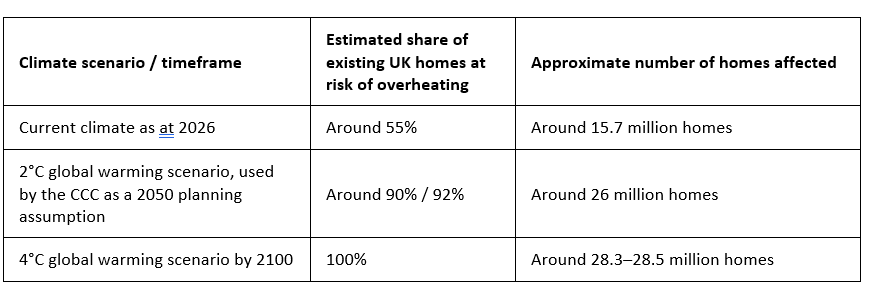
There are several points to note:
First, these are UK-wide estimates. They are not limited to London or the South East, although the risk of heat stress is particularly acute in hotter and more urbanised areas.
Secondly, the 92% figure does not mean that 92% of homes are overheating today. The current estimate is already serious, at around 55% of UK homes. The 92% figure relates to a future 2°C global warming scenario.
Thirdly, the figure does not mean that 92% of homes will be uninhabitable. It means they are projected to fail recognised overheating criteria unless further adaptation takes place.
Clearly, these numbers matter for property professionals. They demonstrate unequivocally that overheating is now a mainstream residential property risk.
For residential conveyancers and homeowners, the central question is simple: will this home remain safe, comfortable and usable in a hotter climate? That question is increasingly relevant to buyers, lenders, landlords, developers, housing associations, insurers and their advisers.
The above figures also need to be seen in the context of the Law Society’s 2025 Climate Change Practice Note and its Supplementary Technical Note on climate change and property. These papers make it clear that property lawyers may need to consider climate-related risks which could affect the property, the client’s intended use, value, insurability, lending, future costs or regulatory position. Heat stress is plainly one of those risks.
The CCC’s figures show that overheating is one of the most serious physical climate risks for the existing UK housing stock, and one which property lawyers, conveyancers and other advisers will increasingly need to understand, identify and explain to homebuyers and sellers.
About the author
Stephen Sykes is Managing Director of Terra IQ Limited. He has been consulted by the Law Society of England and Wales on climate risk-related matters since 2022, including in relation to climate risk and property transactions.